



Tashkent, Uzbekistan, 15-16 October 2024 – A representative of the Secretariat of the Interstate Commission on Sustainable Development (ICSD) participated in the Validation Regional Workshop of the study titled "Leveraging Synergies: Integrative Land-Biodiversity-Climate Action for Improved Monitoring, Reporting, and Investment in Sustainable Agri-Food System Tansformations in Central Asia," organized by the International Rice Research Institute (IRRI), the International Center for Agricultural Research in the Dry Areas (ICARDA), and the Deutsche Gesellschaft für Internationale Zusammenarbeit (GIZ) under the Integrated Land Use for Climate Resilient Development in Central Asia (ILUCA) programme, with the support of the Ministry of Ecology, Environmental Protection and Climate Change of the Republic of Uzbekistan.
The workshop brought together approximately 70 representatives of government agencies, research institutions, international organizations, and environmental initiatives from all Central Asian countries to discuss the findings of a regional study aimed at identifying synergies among sustainable land management, biodiversity conservation, and climate change adaptation objectives.
During the workshop, participants were presented with the results of a comprehensive regional study developed with the contribution of the Secretariat of the Economics of Land Degradation (ELD) Initiative and the International Rice Research Institute (IRRI). The study provides an assessment of existing land governance mechanisms across Central Asia and offers recommendations for strengthening the integration of national policies on land use, biodiversity conservation, and climate action.
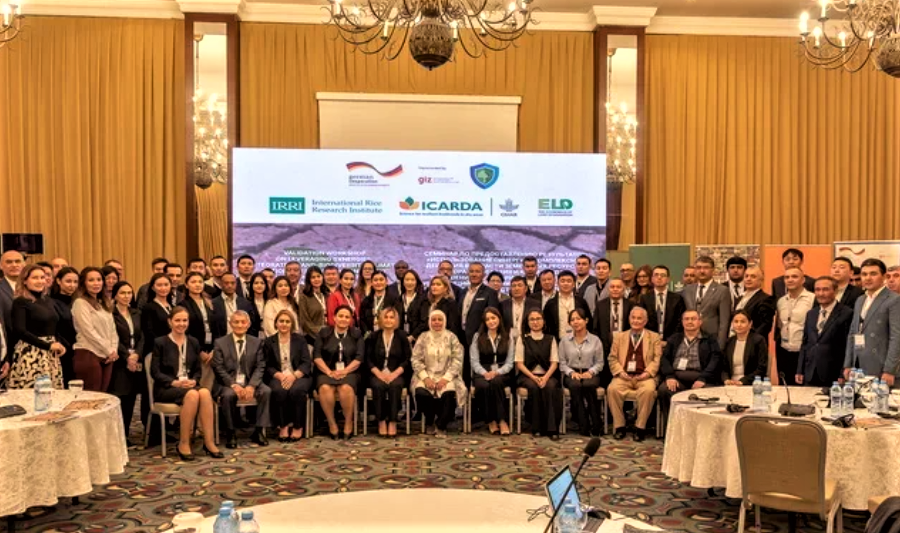 Participants of the Validation Regional Workshop. Photocredit to organizers of the event.
Particular attention was devoted to exploring opportunities for translating the study's findings into national policy and practice. Participants engaged in thematic working group discussions focused on integrating the study's recommendations into national policy frameworks, identifying institutional mechanisms for implementation, mobilizing financial and technical resources, and developing national action plans for land restoration.
The representative of the ICSD Secretariat actively contributed to the expert discussions by presenting regional experiences in sustainable natural resource management and emphasizing the importance of cross-sectoral cooperation to achieve synergies among the three Rio Conventions - the United Nations Convention to Combat Desertification (UNCCD), the Convention on Biological Diversity (CBD), and the United Nations Framework Convention on Climate Change (UNFCCC). Special emphasis was placed on the role of regional cooperation mechanisms in advancing integrated approaches to sustainable land management and climate change adaptation.
On the second day of the workshop, participants jointly developed draft national roadmaps for implementing the study's recommendations, identifying priority actions, responsible institutions, required resources, and monitoring indicators. A dedicated session also explored the future role of the ILUCA programme in strengthening regional cooperation, enhancing monitoring and reporting systems, supporting integrated land-use planning, building institutional capacities, and facilitating knowledge exchange among Central Asian countries.
At the conclusion of the workshop, participants reaffirmed the importance of coordinated regional action to address the interconnected challenges of land degradation, biodiversity loss, and climate change. The study's findings and the draft national action plans will serve as an important foundation for strengthening public policies, enhancing interagency cooperation, and expanding regional collaboration across Central Asia.
The participation of the ICSD Secretariat in this event is fully aligned with the Commission's mandate to promote the integration of environmental considerations into sustainable development processes in Central Asia and to support the implementation of the Regional Environmental Programme for Sustainable Development in Central Asia (REP4SD) 2020-2030. The ICSD remains committed to advancing science-based approaches to sustainable land management, ecosystem conservation, and the achievement of the Sustainable Development Goals throughout the region.
The event contributes to the achievement of:
| Priority Area No 5 dedicated to SDG 15: “Protect, restore and promote sustainable use of terrestrial ecosystems” |
| 5.1.1 Integration of the ecosystem approach for climate change adaptation at the strategic, programmatic and project levels to improve cross-sectoral collaboration (and sectoral plans) and ecosystem protection, restoration and sustainable management. |
| 5.1.2 Capacity-building for sustainable management of forests, land, and pastures. |
| 5.1.7 use of modern monitoring methods to account for flora and fauna species, ecosystem conditions, land resources. |
| Priority area No 6 of REP4SD dedicated to SDG 17: “Strengthen the means of implementation and revitalize the Global Partnership for Sustainable Development” |
| 6.1 Involvement of the region into implementation of global environmental conventions, programmes and initiatives. |