


Ashgabat, Turkmenistan, 22 May 2026 — An important seminar dedicated to ecosystem management was held in Ashgabat on the occasion of the International Day for Biological Diversity. The event was fully organized by the UNDP-GEF project “Conservation and Sustainable Management of Land Resources and High Nature Value Ecosystems in the Aral Sea Basin”, implemented jointly with the Ministry of Environmental Protection of Turkmenistan.
Exactly twenty-five years ago, in 2001, the United Nations General Assembly proclaimed 22 May as the International Day for Biological Diversity. The Convention on Biological Diversity (CBD) itself was adopted in 1992 and will mark its thirty-fifth anniversary next year.
This year’s theme, “Local Action for Global Impact,” aptly reflects the essence of biodiversity conservation efforts.
For Turkmenistan, which is a Party to the three Rio Conventions and all major regional environmental agreements concerning the protection of individual species, including the Siberian crane and the saiga antelope, this date holds particular significance.
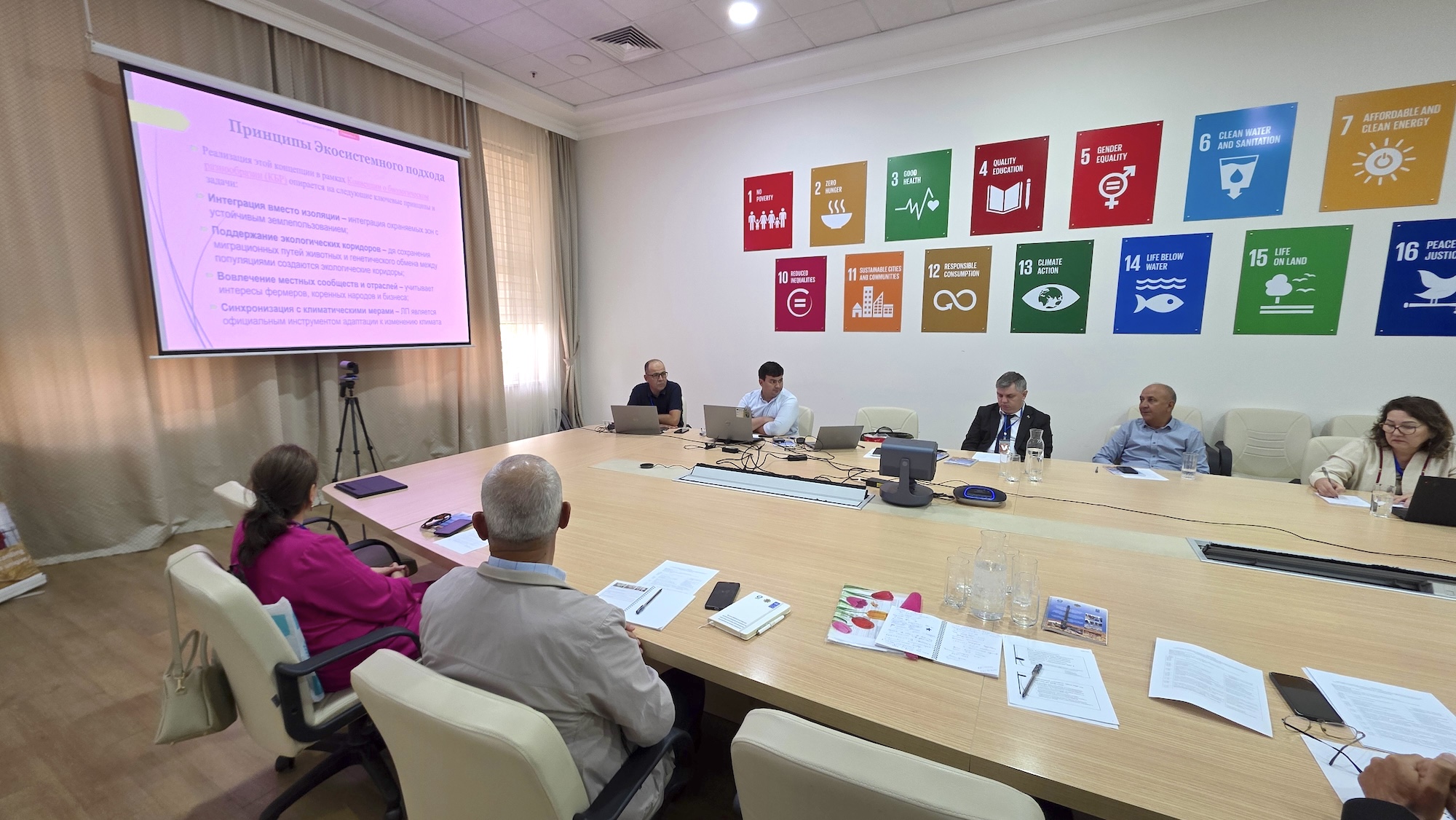 Seminar on ecosystem management. Photocredit to SIC ICSD.
The seminar served as an authoritative platform for discussing practical measures to implement the Kunming-Montreal Global Biodiversity Framework in Turkmenistan. Participants, including heads of scientific departments of key state nature reserves, leading experts, and representatives of relevant government institutions, focused on four major practical areas. Discussions addressed the integration of the concepts of ecological corridors and Other Effective Area-Based Conservation Measures (OECMs) into national legislation, as well as practical approaches to maintaining migratory routes and ecological connectivity between arid and riverine ecosystems within the Amu Darya basin. Additional topics included the application of GIS and digital technologies for accurate ecological corridor mapping, the development of regulated ecotourism, and the creation of alternative livelihood opportunities for local communities.
The results achieved through the joint efforts of the Aral Sea Project and the Ministry of Environmental Protection establish a solid foundation for long-term sustainable economic planning, reducing anthropogenic pressure on protected areas, and promoting greater private sector engagement in biodiversity conservation.
The keynote presentation was delivered by Convention Focal Point and Candidate of Biological Sciences Jumamurad Saparmuradov. He noted that the International Day for Biological Diversity is a significant occasion for Turkmenistan’s environmental community, symbolizing the dedicated efforts of protected area specialists and scientific researchers. His presentation highlighted the landscape approach to natural resource management, which integrates ecological, social, and economic considerations, complements ecosystem-based approaches, and directly links the principles of the Convention on Biological Diversity with specific landscapes and territories across the country.
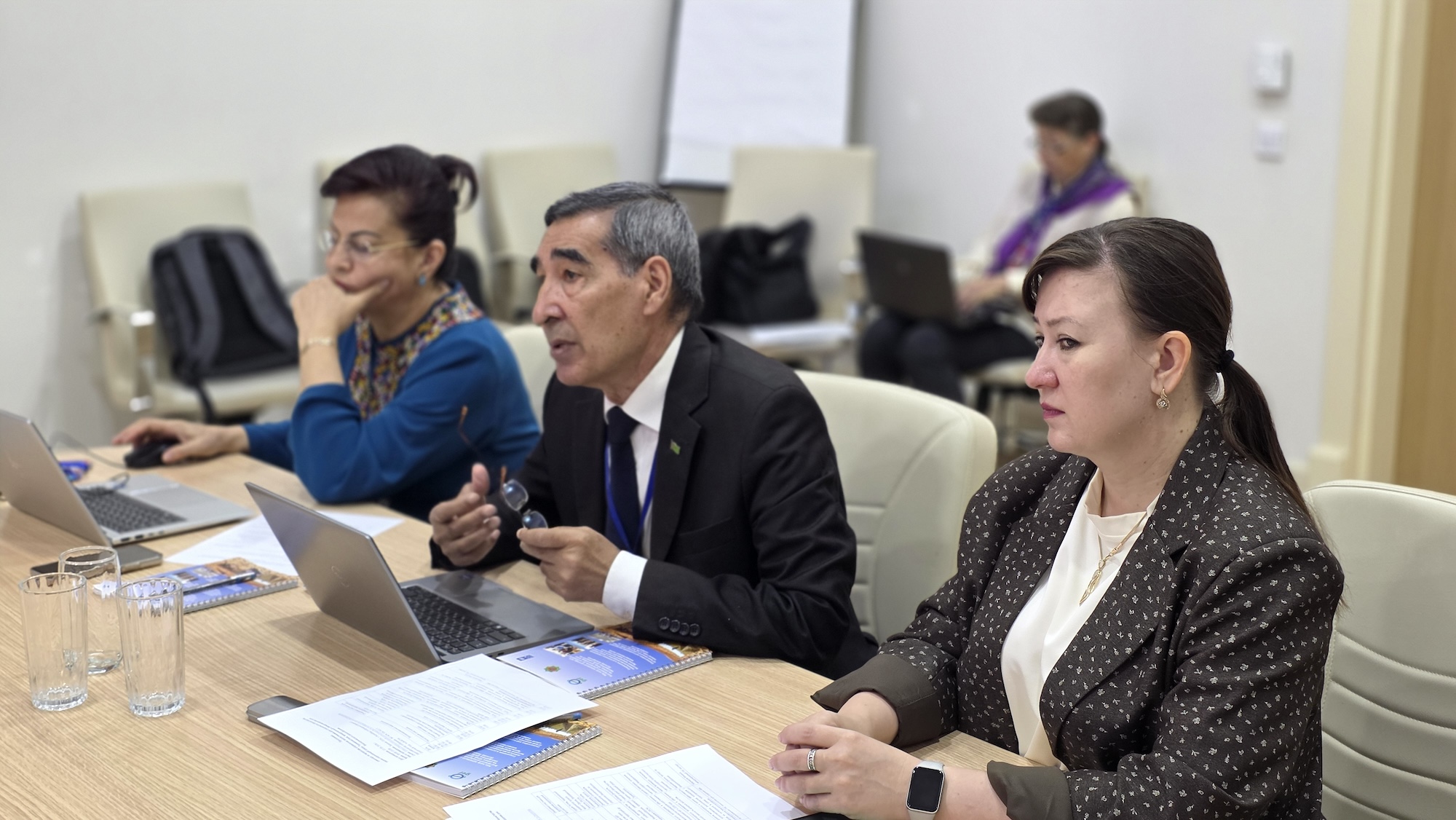 Presentation delivered by CBD Convention Focal Point. Photocredit to SIC ICSD.
A central principle of the landscape approach is “integration rather than isolation.” This concept emphasizes strengthening ecological connectivity among neighboring ecosystems across borders to prevent habitat fragmentation, population isolation, and subsequent ecosystem degradation.
Particular emphasis was placed on the role of local communities, farmers, and indigenous populations in synchronizing biodiversity conservation measures. Such approaches are closely aligned with efforts to enhance both human and ecosystem resilience to the impacts of climate change. Promoting the integrated conservation of fragmented ecosystems elevates biodiversity issues from a sector-specific concern to a broader national planning priority.
In the area of legislative harmonization and the introduction of new conservation designations, the project extends beyond theoretical considerations by supporting the incorporation of innovative legal mechanisms into national legislation. Joragul Khalbayeva, Chief Legal Adviser of the Ministry of Environmental Protection, presented ongoing efforts to prepare national legal instruments, secondary legislation, programme documents, and environmental reporting related to the Sustainable Development Goals.
Addressing the topic of ecological corridors, she noted that work is currently underway to establish a legal definition of the concept, which is intended to facilitate wildlife movement between separate protected areas. By bringing together the scientific leadership of two of Turkmenistan’s key protected areas, the seminar helped translate theoretical land-use planning concepts into practical conservation management approaches.
Representatives of the Amu Darya and Kaplankyr State Nature Reserves shared their experience in combining biodiversity research with conservation activities. Environmental specialists have access to modern equipment provided through the Aral Sea Project, including smartphones, tablets, and camera traps. An important contribution of the seminar was the demonstration of how these digital tools are being applied for ecological corridor mapping and long-term monitoring of their effectiveness.
Akhmetjan Sadykov, representing the Amu Darya Nature Reserve, explained that the reserve consists of three separate sites and one sanctuary established in 1970 to protect wintering wetland birds. Given the fragmented nature of the Amu Darya valley, where protected areas are interspersed with forestry lands and pastures, ecological corridors are essential for maintaining populations of the Bukhara deer (tugai deer).
Arazmurat Amanov of the Kaplankyr Nature Reserve highlighted the importance of northern Turkmenistan’s lakes, particularly Lake Sarykamysh, as critical stopover sites for migratory birds. His presentation also addressed migration routes of several threatened ungulate species, including the endemic Ustyurt mouflon, goitered gazelle, and kulan. Although the saiga antelope is listed in Turkmenistan’s Red Data Book, it does not permanently inhabit the area and typically enters Turkmenistan from Kazakhstan during severe winters in search of forage.
Considerable attention was devoted to seasonal conservation measures and the economic dimensions of biodiversity protection. The seminar laid the groundwork for the development of sustainable, regulated ecotourism and alternative income-generating opportunities for local populations.
Such initiatives are planned for implementation within buffer zones, Important Bird Areas (IBAs), and other protected territories. These efforts are expected to increase local participation in the green economy and contribute to reducing anthropogenic pressures on protected areas over the long term.
Biodiversity Analyst Svetlana Isayeva noted that the project addresses multiple dimensions of natural resource management within the Turkmen Aral Sea region. A key guiding framework remains the Kunming-Montreal Global Biodiversity Framework adopted in 2022. Its overarching objective is to strengthen biodiversity conservation efforts by 2030 and contribute to the vision of “Living in Harmony with Nature” by 2050. The Framework includes four goals and twenty-three targets, among them the conservation of at least 30 per cent of areas critical for biodiversity and the creation of conditions that support the natural recovery of species and ecosystems.
As part of international cooperation and with financial support from the “Russian Experts for International Development” programme, a series of field surveys was conducted in 2025. A key outcome of this work was the integration of collected data into a GIS environment with the participation of international programme expert and GIS specialist Mikhail Markarov.
This enabled the visualization of project results through detailed digital maps reflecting the current spatial distribution of species across the study areas. The resulting documentation package also includes wildfire risk maps and an innovative methodology for applying QGIS software to identify and map Important Bird Areas (IBAs) and Key Biodiversity Areas (KBAs). The availability of these practical tools will support the Ministry of Environmental Protection and other relevant institutions in further aligning national environmental legislation and policies with international biodiversity conservation standards.
Prepared by the staff of the UNDP-GEF Aral Sea Project.
The event supports the achievement of:
| Priority Area of REP4SD No 5 dedicated to SDG 15: “Protect, restore and promote sustainable use of terrestrial ecosystems” |
| 5.2.2 strengthening scientific cooperation on restoration of rare and endangered plant and animal species, taking joint measures for their protection; |
| 5.2.3 development of ecological corridors for migratory species of animals and birds, transboundary cooperation on protection of key habitats, including protected areas. |