



Ashgabat, Turkmenistan, 10 June 2026 — Experts from the Scientific-Information Center of the Interstate Commission on Sustainable Development of Central Asia (SIC ICSD) participated in an online Technical Meeting dedicated to Enhancement of MODSNOW to an Operational Early Warning Information System. The event was organized by the GFZ German Research Centre for Geosciences with the support of German Society for International Cooperation under the Climate Risk Management in Central Asia project. The meeting brought together representatives of the national hydrometeorological services of the Central Asian countries, the Basin Water Organizations of the Amu Darya and Syr Darya Rivers, as well as experts from international and regional organizations working on drought monitoring and forecasting.
The primary objective of the meeting was to present the results of GFZ's work on enhancing the MODSNOW system and transforming it into a fully operational early warning information system capable of providing timely drought forecasts and supporting decision-making in the context of climate change. Particular attention was devoted to the development of a new drought forecasting module for the Khorezm-Dashoguz pilot transboundary area, encompassing border regions of Uzbekistan and Turkmenistan.
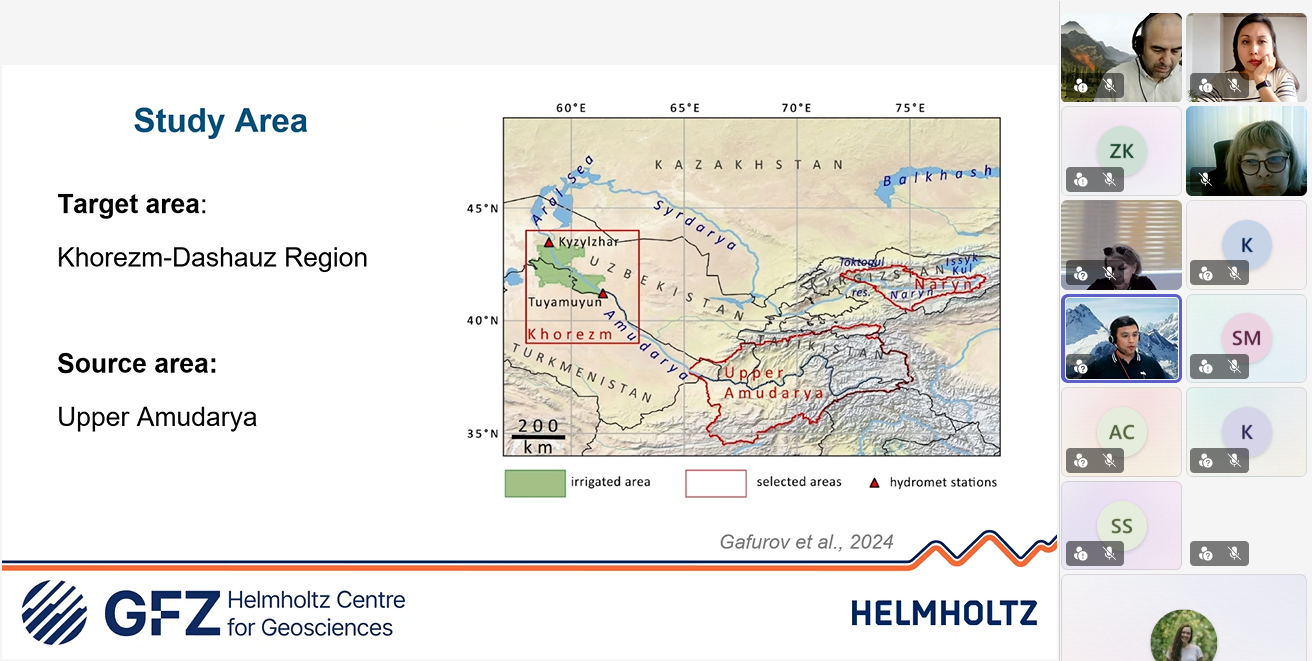
Analysis conducted for the Khorezm-Dashoguz pilot transboundary area. Photocredit to SIC ICSD.
The keynote presentation was delivered by Dr. Abror Gafurov, who introduced participants to modern approaches to drought modelling based on satellite observations, hydrometeorological data, and remote sensing technologies. The presentation demonstrated how climate and hydrological datasets can be integrated to generate operational drought forecasts, assess the likelihood of drought occurrence, and improve the effectiveness of early warning systems.
During the discussion session, participants exchanged views on further improving drought forecasting methodologies, the potential application of modelling results by national hydrometeorological services, and opportunities for integrating new analytical tools into existing regional climate risk monitoring mechanisms. Particular emphasis was placed on enhancing forecasting accuracy, strengthening data exchange among the countries of Central Asia, and promoting inter-institutional cooperation on climate change adaptation.
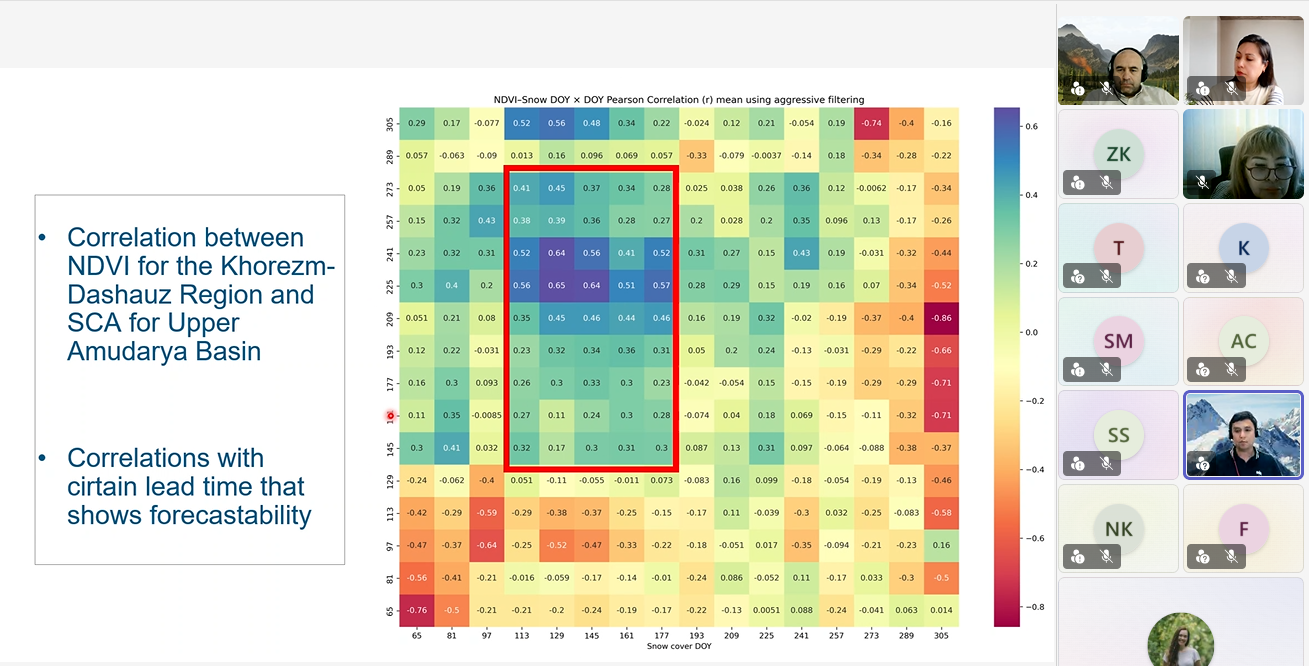 Conducted Assessment of the Khorezm-Dashoguz pilot transboundary area. Photocredit to SIC ICSD.
The participation of SIC ICSD in the Technical Meeting reflects the Centre's continued commitment to strengthening scientific and analytical cooperation across the region, promoting the application of advanced digital technologies for environmental monitoring, and expanding collaboration with international partners. Against the backdrop of increasing climate change impacts, the development of regional drought early warning systems is becoming an essential instrument for enhancing the resilience of natural ecosystems, supporting the sustainable management of land and water resources, and strengthening environmental security and sustainable development throughout Central Asia.
The event supports the achievement of:
| Priority Area No 5 of REP4SD dedicated to SDG 15: “Protect, restore and promote sustainable use of terrestrial ecosystems” |
| 5.1.7 use of modern monitoring methods to account for flora and fauna species, ecosystem conditions, land resources. |
| Priority area No 6 of REP4SD dedicated to SDG 17: “Strengthen the means of implementation and revitalize the Global Partnership for Sustainable Development” |
| 6.1 Involvement of the region into implementation of global environmental conventions, programmes and initiatives. |