



Tbilisi, Georgia, 28 February 2024 – A representative of the Scientific-Information Center of the Interstate Commission on Sustainable Development (SIC ICSD) actively participated in the international webinar “A Closing Conversation with Georgia – Reflections on its Capacity-building Initiative for Transparency (CBIT) Project,” organized under the Capacity-building Initiative for Transparency – Global Support Programme (CBIT-GSP). The programme is implemented by the United Nations Environment Programme (UNEP) in cooperation with the UNEP Copenhagen Climate Centre (UNEP-CCC) and funded by the Global Environment Facility (GEF).
The international webinar brought together representatives of government institutions, international organizations, national CBIT project teams, climate transparency experts, and representatives of countries implementing or preparing projects aimed at strengthening national capacities under Article 13 of the Paris Agreement. The primary objective of the event was to facilitate the exchange of practical experience gained through the implementation of Georgia’s CBIT project, discuss its achievements and lessons learned, and explore opportunities for further strengthening national climate transparency systems during the transition to the Enhanced Transparency Framework (ETF).
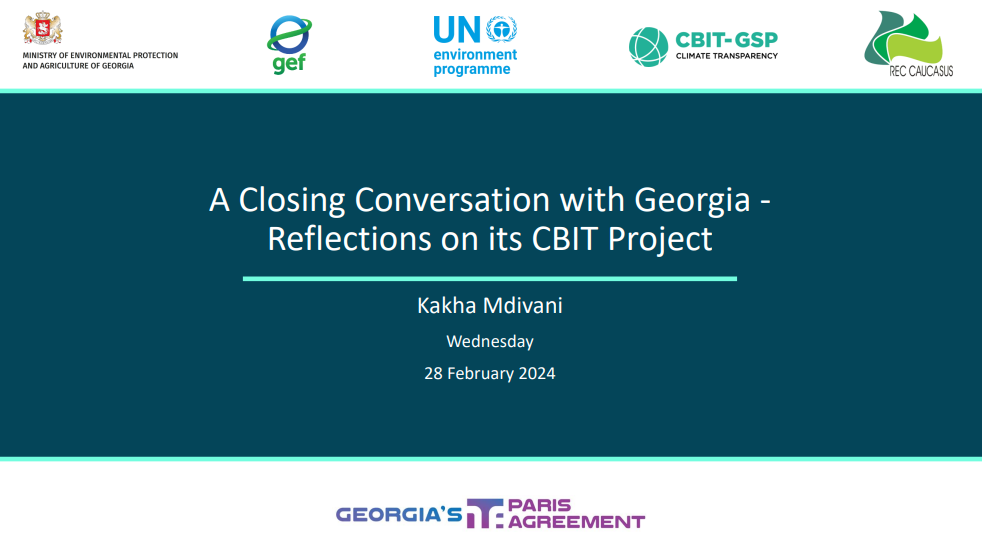 Outcomes of the CBIT Project Implementation in Georgia. Photocredit to organizers of the event.
During the opening session, representatives of the UNEP Copenhagen Climate Centre presented the activities of the CBIT Global Support Programme, highlighting its role in assisting countries in establishing sustainable institutional arrangements necessary to meet the transparency requirements of the Paris Agreement, including monitoring, reporting and verification (MRV) of climate action.
During the main session, the Chief Technical Adviser of Georgia’s CBIT Project from the Regional Environmental Centre for the Caucasus (REC Caucasus) provided a comprehensive overview of the national project, presenting its objectives, key components, achievements and institutional reforms undertaken to prepare the country for the implementation of the Enhanced Transparency Framework. Particular emphasis was placed on strengthening the national greenhouse gas inventory system, improving inter-institutional coordination mechanisms, enhancing the technical capacities of relevant national institutions, and establishing a sustainable framework for the preparation of Biennial Transparency Reports (BTRs).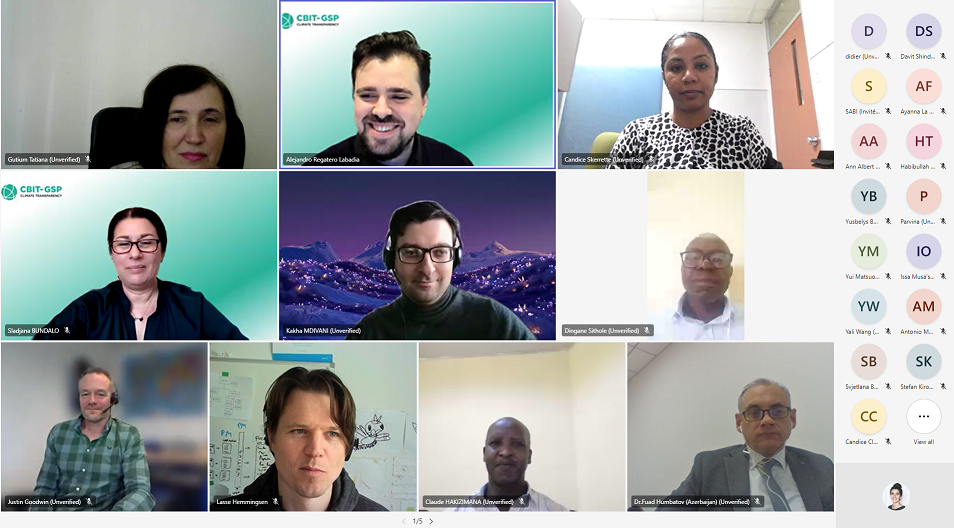
Participants of the online webinar dedicated to the CBIT Project Implementation in Georgia. Photocredit to organizers of the event.
During the expert discussion, the Georgian delegation shared practical lessons learned throughout the implementation of the project, including successful approaches to institutional coordination, ensuring the sustainability of newly established mechanisms, and integrating the requirements of the Paris Agreement into national decision-making processes. Participants discussed effective approaches for addressing institutional and technical challenges associated with the implementation of the Enhanced Transparency Framework, as well as opportunities for adapting Georgia's experience to other national contexts.
Particular interest was generated by the regional presentation delivered by the Regional Coordinator of the Eurasia Transparency Network under the CBIT-GSP Programme, which focused on strengthening regional cooperation, expanding professional networks of transparency experts, and enhancing knowledge-sharing mechanisms related to climate reporting. During the discussion, participants emphasized that sustainable regional cooperation platforms represent one of the key enabling factors for the successful implementation of the transparency provisions of the Paris Agreement.
The representative of SIC ICSD actively participated in the expert discussions and question-and-answer session addressing institutional development of national transparency systems, enhancement of climate reporting processes, and promotion of international cooperation through CBIT projects. Particular attention was given to the application of international best practices for further strengthening monitoring, reporting and verification systems in the countries of Central Asia, as well as expanding regional cooperation on climate transparency.
At the conclusion of the webinar, participants reaffirmed the importance of continuous peer-to-peer exchange among countries implementing CBIT projects as an effective mechanism for strengthening national capacities and improving the implementation of commitments under the United Nations Framework Convention on Climate Change (UNFCCC) and the Paris Agreement. The practical knowledge and recommendations shared during the event are expected to contribute to the further development of national and regional climate transparency systems, the strengthening of institutional frameworks for climate reporting, and enhanced cooperation between national institutions and international partners.
The participation of SIC ICSD in the CBIT-GSP international webinar contributes to strengthening scientific and information cooperation on climate transparency and supports the implementation of the priorities of the Regional Environmental Programme for Sustainable Development of Central Asia (REP4SD-CA) 2020-2030, particularly those related to enhancing regional cooperation on climate change, improving climate monitoring and reporting systems, strengthening the institutional capacities of the Central Asian countries, and increasing the effectiveness of the implementation of commitments under the Paris Agreement.
The event supports the achievement of:
| Priority Area of REP4SD No 4 dedicated to SDG 13: “Take urgent action to combat climate change and its impacts” |
| 4.3 Assessment of climate risks and vulnerabilites through the application of corresponding models of a climate change impact on water resources, terrestrial ecosystems and natural disasters, tackling the development of state policies and strategies in this area. |