



Online, 23 July 2026 – Representatives of the Scientific-Information Centre of the Interstate Commission on Sustainable Development (SIC ICSD) participated in the second day of the Regional Online Meeting of the Parties to Annex II of the United Nations Convention to Combat Desertification (UNCCD), convened by the UNCCD Secretariat as part of the preparations for the seventeenth session of the Conference of the Parties (COP 17), to be held from 17 to 28 August 2026 in Ulaanbaatar, Mongolia. The meeting brought together representatives of Asian countries, the UNCCD Secretariat, members of the Committee on Science and Technology (CST), the Committee for the Review of the Implementation of the Convention (CRIC), as well as National Focal Points and experts involved in preparations for the COP 17 negotiation process.
The second day of the meeting focused on the future sessions of the CST and the CRIC, as well as on the Convention’s science-policy agenda, strengthening knowledge-sharing mechanisms, enhancing the capacity of Parties, and improving the effectiveness of national reporting. Representatives of the UNCCD Secretariat presented in detail the documents that will be considered by the Committee on Science and Technology during COP 17, including draft decision ICCD/COP(17)/CST/3 on Knowledge sharing, technology transfer and innovation, ICCD/COP(17)/CST/4 on Avoiding, reducing and reversing land and soil degradation of agricultural lands, and ICCD/COP(17)/CST/5, addressing the Preparation for the future functioning of the Science-Policy Interface.
During the discussions, particular emphasis was placed on strengthening the role of scientific evidence in shaping international policies for sustainable land management. Experts highlighted the importance of expanding the application of Earth observation technologies, digital platforms, artificial intelligence and innovative analytical tools to support evidence-based decision-making at both national and regional levels. It was noted that the further development of the Science-Policy Interface should promote closer integration of scientific research into policy formulation and decision-making processes under the Convention.
Participants expressed considerable interest in the presentation of the new Agrifood Systems Technologies and Innovations Outlook – Knowledge Base (ATIO KB), developed by the Food and Agriculture Organization of the United Nations (FAO). The platform serves as a modern knowledge-sharing system bringing together guidance, technologies, practical tools and innovative solutions for sustainable agrifood systems. Through the use of artificial intelligence, users will be able to identify practical solutions for various aspects of land management that are tailored to national contexts and thematic priorities.
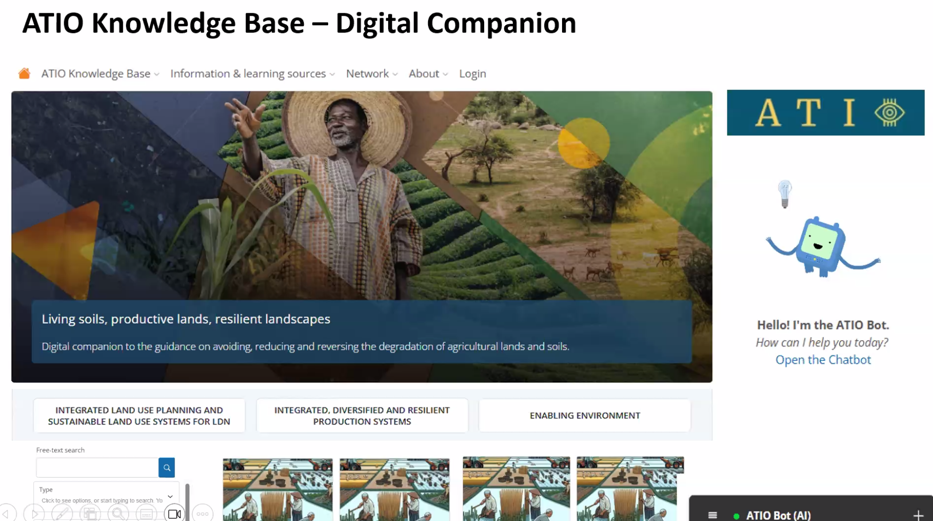 Information about the Agrifood Systems Technologies and Innovations Outlook – Knowledge Base (ATIO KB) platform. Photocredit to SIC ICSD.
A dedicated session focused on capacity development for Parties to the Convention. Representatives of the UNCCD Secretariat presented the key elements of the Capacity-Building Strategy currently being developed pursuant to Decision 2/COP.16. It was emphasized that the new strategy adopts a comprehensive approach to strengthening institutional, organizational and individual capacities through the expansion of e-learning in all official United Nations languages, the deployment of innovative digital solutions, the development of regional support centres, the application of artificial intelligence, and the expansion of programmes targeting women, youth and representatives of the most vulnerable communities. Particular attention is being given to ensuring the long-term sustainability of regional support centres established to facilitate national reporting and support the implementation of the Convention.
Within the framework of the Committee for the Review of the Implementation of the Convention (CRIC), documents ICCD/CRIC(24)/3, ICCD/CRIC(24)/4 and ICCD/CRIC(24)/5 were presented, addressing improvements to national reporting procedures, the further development of technical support mechanisms for Parties and the enhancement of data quality. Participants were informed of the significant progress achieved in establishing a new support architecture based on regional support hubs and specialized technical advisory institutions. At the same time, persistent challenges were identified, including disparities in national capacities, the processing of large Earth observation datasets, limited access to high-quality geospatial information, and the need for the timely operationalization of funding from the Global Environment Facility (GEF).
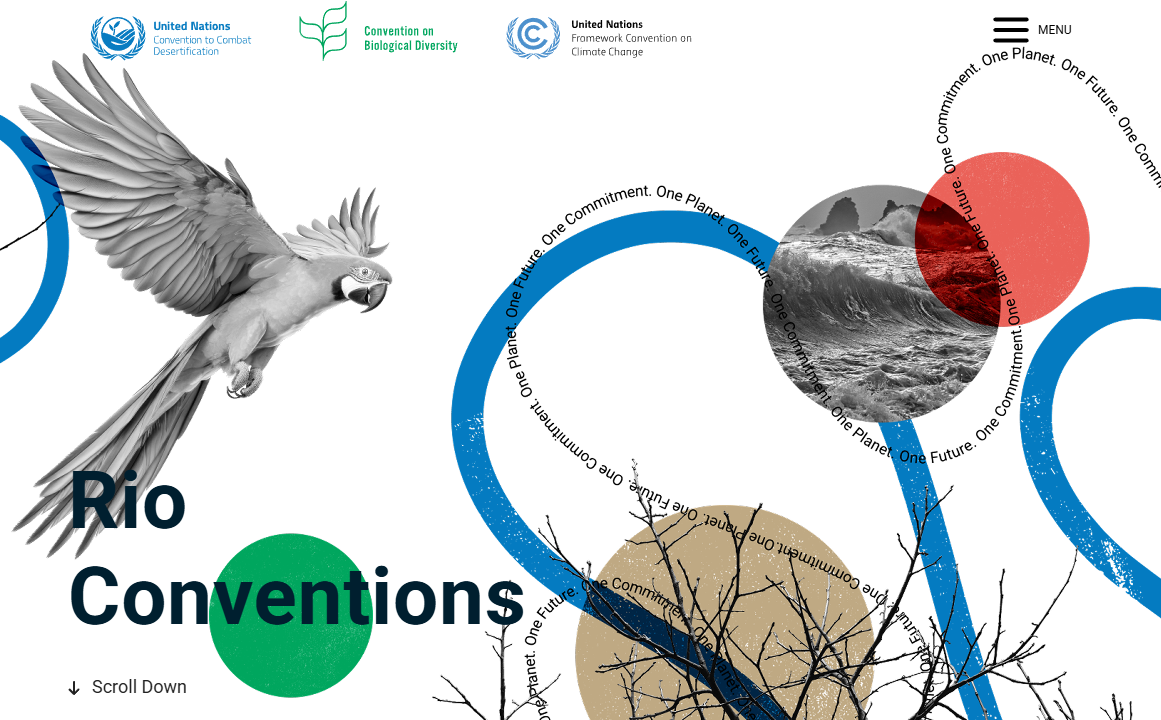 Information about the three Rio Conventions' Synergies Portal. Photocredit to SIC ICSD.
A prominent part of the programme was devoted to strengthening synergies among the three Rio Conventions — the United Nations Convention to Combat Desertification (UNCCD), the United Nations Framework Convention on Climate Change (UNFCCC) and the Convention on Biological Diversity (CBD). Representatives of the UNCCD Secretariat presented draft decision ICCD/COP(17)/12, which aims to further promote coordinated implementation of the three Conventions at the national level. The document encourages Parties to strengthen coordination among the national focal points of the Rio Conventions, enhance the coherence of national strategies, plans and targets, expand the application of Nature-based Solutions and ecosystem-based approaches, promote sustainable food systems, and prioritize projects that generate multiple environmental and socio-economic benefits.
The meeting also provided updates on the work of the Joint Liaison Group (JLG) of the three Rio Conventions, the launch of the joint information portal rioconventions.org in 2025, the preparation of joint initiatives on sustainable food systems, and the development of a new GEF-funded project aimed at strengthening national coordination for the implementation of commitments under the three Rio Conventions.
The information materials, draft decisions and analytical documents presented during the meeting constitute an important practical resource for the preparation of national delegations for COP 17. They provide timely insights into the key issues expected to shape the negotiations, facilitate an understanding of emerging developments in the Convention’s science-policy agenda, and support the development of national positions on capacity development, strengthening the science-policy interface, enhancing regional cooperation and advancing synergies among the Rio Conventions.
The participation of SIC ICSD representatives in the regional meeting contributes to strengthening scientific and information cooperation among the countries of Central Asia, enhancing regional capacities for sustainable land management, and supporting the effective implementation of the Regional Environmental Programme for Sustainable Development of Central Asia (REP4SD) 2020-2030. The outcomes of the meeting are of particular importance for promoting integrated approaches to implementing the three Rio Conventions, improving national monitoring and reporting systems, and advancing the application of modern scientific and digital tools in decision-making processes related to combating land degradation, addressing climate change and conserving biodiversity.
The event contributes to the achievement of:
| Priority Area No 5 dedicated to SDG 15: “Protect, restore and promote sustainable use of terrestrial ecosystems” |
| 5.1.1 Integration of the ecosystem approach for climate change adaptation at the strategic, programmatic and project levels to improve cross-sectoral collaboration (and sectoral plans) and ecosystem protection, restoration and sustainable management. |
| 5.1.2 Capacity-building for sustainable management of forests, land, and pastures. |
| 5.1.7 use of modern monitoring methods to account for flora and fauna species, ecosystem conditions, land resources. |
| Priority area No 6 of REP4SD dedicated to SDG 17: “Strengthen the means of implementation and revitalize the Global Partnership for Sustainable Development” |
| 6.1 Involvement of the region into implementation of global environmental conventions, programmes and initiatives. |