




Ashgabat, Turkmenistan, 3-5 April 2024 — Representatives of the Scientific-Information Center of the Interstate Commission on Sustainable Development (SIC ICSD) participated in the Practical Training Workshop entitled “Land Use Category Classification and Quality Assurance/Quality Control (QA/QC) Procedures,” held under the Capacity-building Initiative for Transparency – Global Support Programme (CBIT-GSP). The event was organized with the support of the United Nations Environment Programme (UNEP), the UNEP Copenhagen Climate Centre (UNEP-CCC), the Food and Agriculture Organization of the United Nations (FAO), and the United Nations Development Programme (UNDP) in Turkmenistan.
The training was aimed at strengthening Turkmenistan’s national capacity to prepare greenhouse gas inventories for the land use, land-use change and forestry (LULUCF) sector in accordance with the requirements of the United Nations Framework Convention on Climate Change (UNFCCC) and the Enhanced Transparency Framework under the Paris Agreement. Particular attention was given to the application of the 2006 Intergovernmental Panel on Climate Change (IPCC) Guidelines and the use of the IPCC Inventory Software for the preparation of national inventories.
The training brought together specialists from relevant ministries and agencies, national experts and representatives of scientific institutions involved in data collection, development of national parameters and the preparation of climate reports. Over the course of three days, participants reviewed methodological approaches to land use category classification, development of land-use matrices, and the organization of quality assurance and quality control procedures. They also undertook practical exercises on data entry and processing using the IPCC Inventory Software.
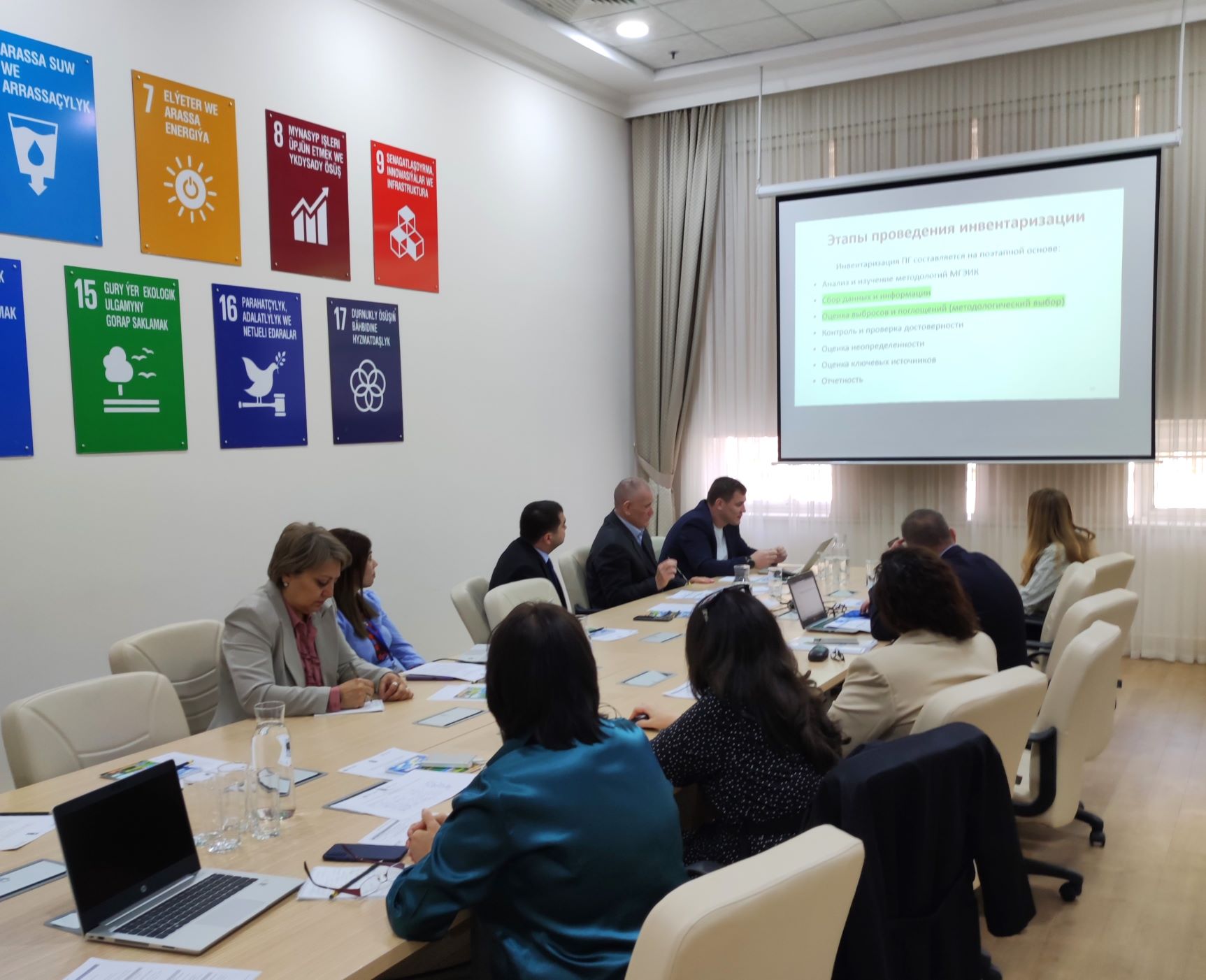 Practical Training Workshop in progress. Photocredit to UNDP Turkmenistan.
The practical sessions covered all major land use categories, including forest land, cropland, grassland, wetlands, settlements and other land. Participants were also introduced to tools for compiling and reporting results for the LULUCF sector, which is of particular importance for the preparation of Turkmenistan’s first Biennial Transparency Report. Main outcomes of the Practical Training can be found on CBIT-GSP website.
The participation of SIC ICSD representatives in the training contributed to the exchange of regional experience and to strengthening cooperation between national and regional expert institutions. The knowledge and practical skills acquired during the workshop will support the further enhancement of national greenhouse gas monitoring systems and promote the comparability of climate reporting across the countries of Central Asia in the context of implementing international commitments on climate change and sustainable development.
The event supports the achievement of:
| Priority Area of REP4SD No 4 dedicated to SDG 13: “Take urgent action to combat climate change and its impacts” |
| 4.3 Assessment of climate risks and vulnerabilites through the application of corresponding models of a climate change impact on water resources, terrestrial ecosystems and natural disasters, tackling the development of state policies and strategies in this area. |