



Ashgabat, Turkmenistan, 22 January 2026 – The national project “Strengthening the Capacity of Turkmenistan to Comply with the Enhanced Transparency Framework (ETF) under the Paris Agreement” was officially signed in Ashgabat within the framework of the International Conference on Food Security in the Context of Climate Change, entitled “Health and Nutrition in a Changing Climate.” The conference was jointly organized by the Government of Turkmenistan and the Food and Agriculture Organization of the United Nations (FAO) and was held at the Yyldyz Hotel in the capital city.
The international conference served as an important dialogue platform for discussing the interlinkages between climate change, public health, and the resilience of agri-food systems, as well as contemporary approaches to strengthening food security amid increasing climate risks. The programme included thematic sessions dedicated to the “One Health” approach as a cornerstone of agri-food system transformation, regional initiatives to enhance climate resilience and food security in Central Asia, and a concluding session summarizing the key outcomes of the conference.
The signing of the project represented a key practical outcome of the conference and reaffirmed Turkmenistan’s commitment to fulfilling its international climate obligations under the Paris Agreement. The project aims to strengthen national capacity to meet the requirements of the Enhanced Transparency Framework (ETF) with regard to climate change mitigation and adaptation actions, as well as tracking and reporting on support received for sectors covered by nationally determined contributions (NDCs).
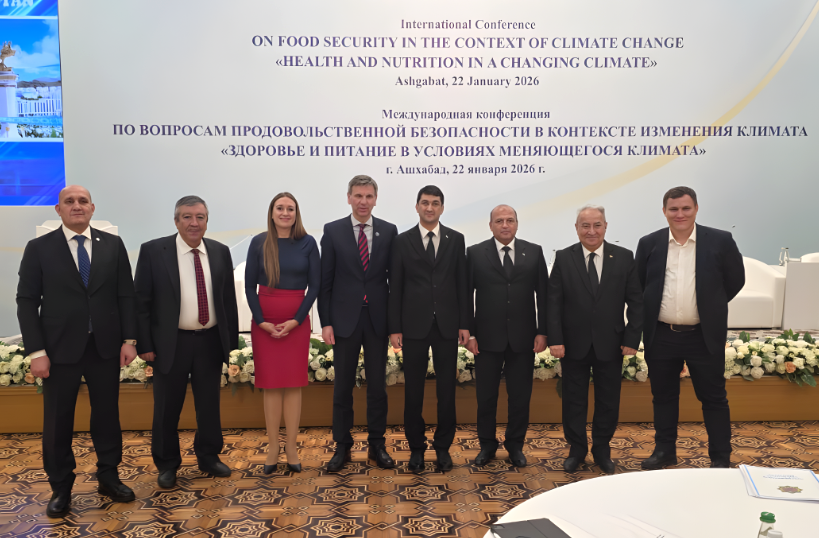 Participants of the International Conference including Government of Turkmenistan, FAO officials and SIC ICSD. Photocredit to CAREC.
The project will be implemented in Turkmenistan by the Scientific Information Centre of the Interstate Commission on Sustainable Development of the International Fund for Saving the Aral Sea (SIC ICSD IFAS), on behalf of the Ministry of Environmental Protection, with the support of the Food and Agriculture Organization of the United Nations (FAO), acting as the implementing agency of the Global Environment Facility (GEF).
The project objectives focus on strengthening the national institutional framework and information management systems to support compliance with the Enhanced Transparency Framework and the development of long-term low-emission development strategies (LT-LEDS), as well as enhancing national technical capacity for the preparation of greenhouse gas inventories and for monitoring and reporting on climate change mitigation measures under the NDCs. Particular attention is also given to strengthening technical capacity for monitoring and reporting on climate change adaptation actions, as well as addressing issues related to loss and damage in the context of NDC implementation.
As a result of the project’s implementation, Turkmenistan will enhance its institutional and technical capacity to comply with the requirements of the Enhanced Transparency Framework of the Paris Agreement. This will be achieved through capacity-building of key stakeholders in monitoring adaptation actions outlined in the NDCs, the systematic preparation of greenhouse gas inventories and tracking of mitigation measures, as well as the accounting and analysis of domestic and international climate finance required and received for the implementation of national climate actions.
The project also contributes to the implementation of the Regional Environmental Programme for Sustainable Development of Central Asia (REP4SD) by ICSD bodies, supporting practical integration of climate transparency goals, institutional development and regional cooperation into the processes of sustainable development of Central Asia.
The event supports the achievement of:
| Priority Area of REP4SD No 4 dedicated to SDG 13: “Take urgent action to combat climate change and its impacts” |
| 4.3 Assessment of climate risks and vulnerabilites through the application of corresponding models of a climate change impact on water resources, terrestrial ecosystems and natural disasters, tackling the development of state policies and strategies in this area. |
| Priority area No 6 of REP4SD dedicated to SDG 17: “Strengthen the means of implementation and revitalize the Global Partnership for Sustainable Development” |
| 6.2 Strengthening of cooperation among international organizations and regional and national institutions for better access to new technologies, preparation of legal and regulatory frameworks, development and implementation of national and regional strategies and plans and development of sustainable financing opportunities. |